
Beyond biologicals: microbial traits as tools for crop improvement
Plant performance depends on two genomes: the plant’s own, and that of the microbes living with it. That opens a second route to improving crop traits.
Beyond biologicals: microbial traits as tools for crop improvement
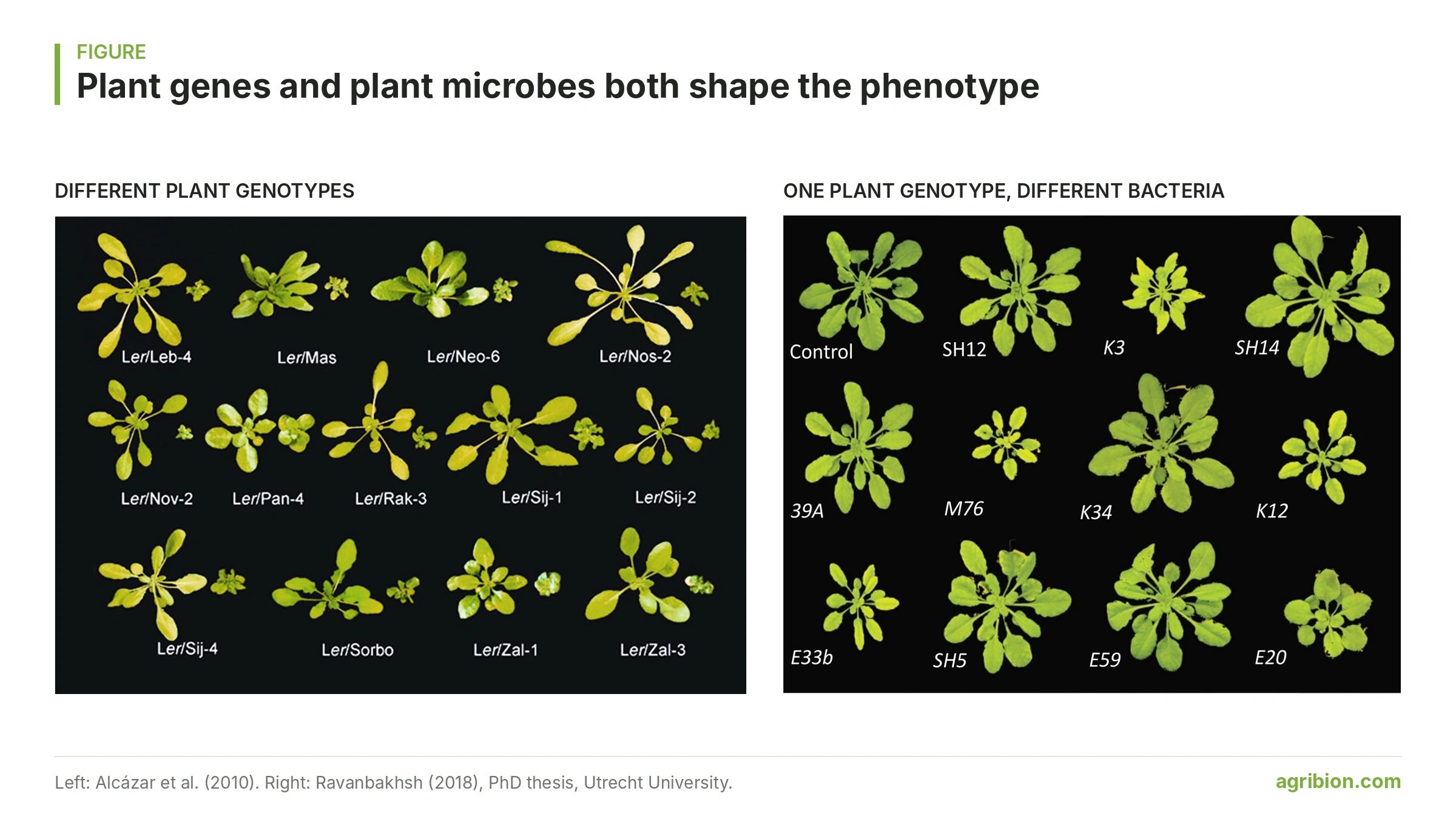
Microbes are usually offered as products that promote growth or protect plants. Their role goes deeper. Specific microbial functions act on plant hormones, changing how plants grow, take up nutrients and respond to stress. The same plant can look very different depending on the bacteria it grows with (Figure 1).
This series shares our research on how those microbial functions can be targeted, what they can cost, and how they can be developed for crops. Each article is short, based on peer-reviewed work, and clear about what has been shown in controlled experiments and what still needs testing in the field.
The question running through the series: which microbial function, for which plant, under which conditions?
The series
Article 1: Improving plant traits through the microbiomes
Changing one bacterial gene can shift a plant trait about as much as changing a plant gene.
Article 2: When growth comes at a cost
A microbial trait that boosts growth in good conditions can become a cost under stress.
Article 3: Harnessing direct evolution
How bacteria with targeted functions can be developed through experimental evolution, without genetic modification.
Written for R&D teams in seed breeding, seed treatment and agricultural biotechnology. Want to discuss a project? Contact Agribion.
Figure 1 (below). Left: Arabidopsis plants of different genetic backgrounds (Alcázar et al., 2010). Right: one Arabidopsis genotype grown with eleven different bacterial strains or without bacteria (control) (Ravanbakhsh, 2018).
Explore the series

Beyond biologicals
When growth comes at a cost
When growth comes at a cost
Microbial traits offer another route to improving plant performance: change microbe traits not plant genome! CLICK HERE!
When growth comes at a cost
When growth comes at a cost
When growth comes at a cost
Greater growth does not always mean greater resilience. Target selection is nevcessary. CLICK HERE!
Harnessing direct evolution
When growth comes at a cost
Harnessing direct evolution
Direct evolution as a route to improving microbial function: we can boost native microbione instead of adding one. CLECK HERE!