Evolved, not engineered: building a bacterial team from one strain
Cover. Schematic of directed evolution from one ancestral strain; results from controlled coriander experiments. Ravanbakhsh & Xiong (2026), Plant, Cell & Environment.
Direct evolution
A bacterium’s plant-beneficial function can be strengthened without genetic modification, by letting it evolve under the stress we want it to solve. From one strain, directed evolution produced a small team of bacteria with complementary traits.
A natural route to a better microbe
In Anrticle 1, we changed one bacterial gene by genetic modification and shifted a plant trait . That shows what is possible, but genetically modified microbes face regulatory and acceptance hurdles in agriculture. Directed evolution takes a natural route: we grow a bacterium for many generations under a chosen pressure and let selection do the work.
One strain, three specialists
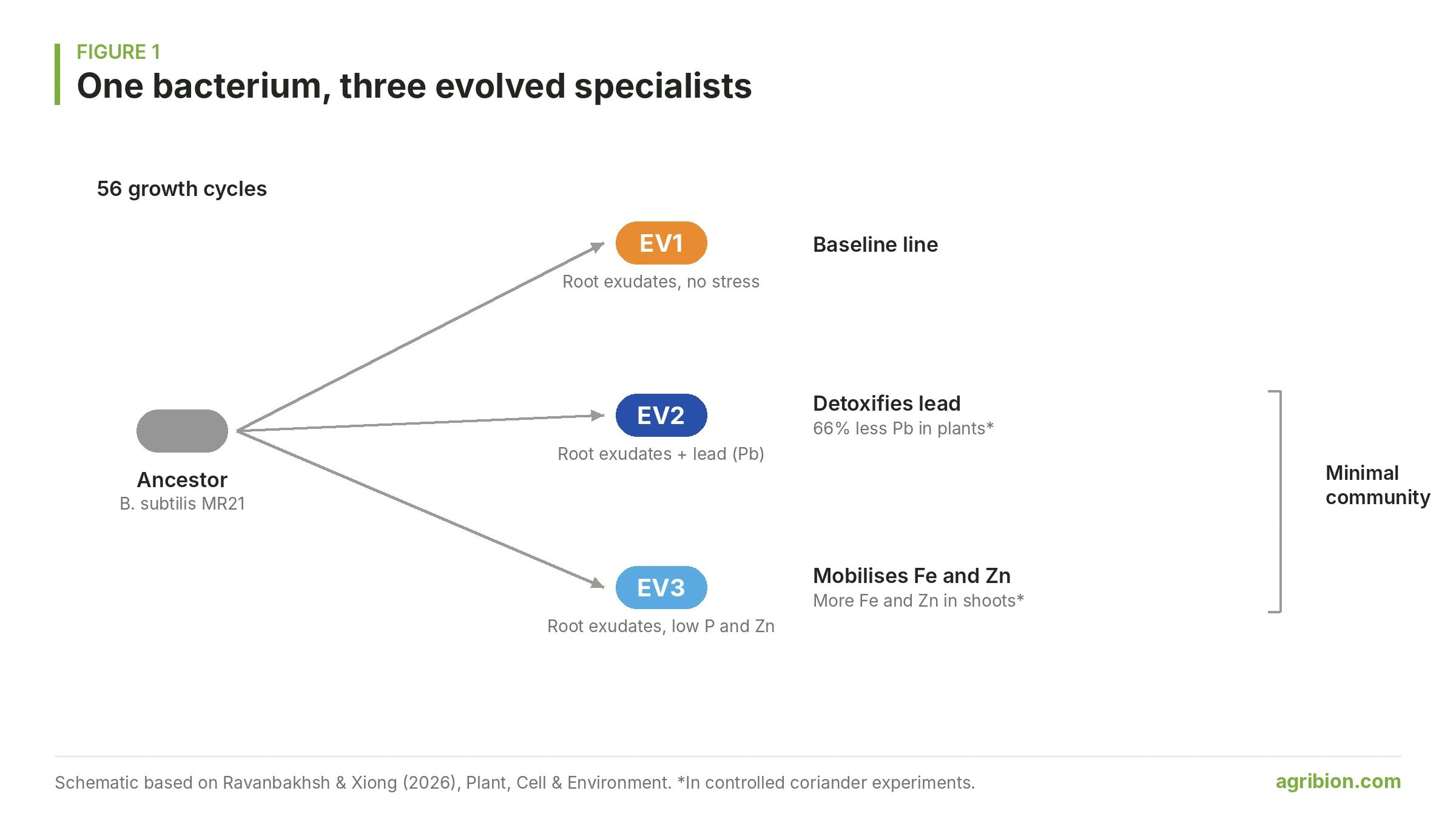
We started from Bacillus subtilis MR21, a plant-associated bacterium originally isolated from tomato roots. Over 56 growth cycles in a medium containing coriander root exudates, we applied three pressures: no added stress, lead toxicity, and low availability of phosphorus and zinc. Each produced a distinct evolved strain (Figure 1).
Make desired strains out of ancestor
Figure 1. One ancestral strain evolved under three conditions into EV1 (no stress), EV2 (lead) and EV3 (low phosphorus and zinc). Schematic based on Ravanbakhsh & Xiong (2026).
What coriander gained
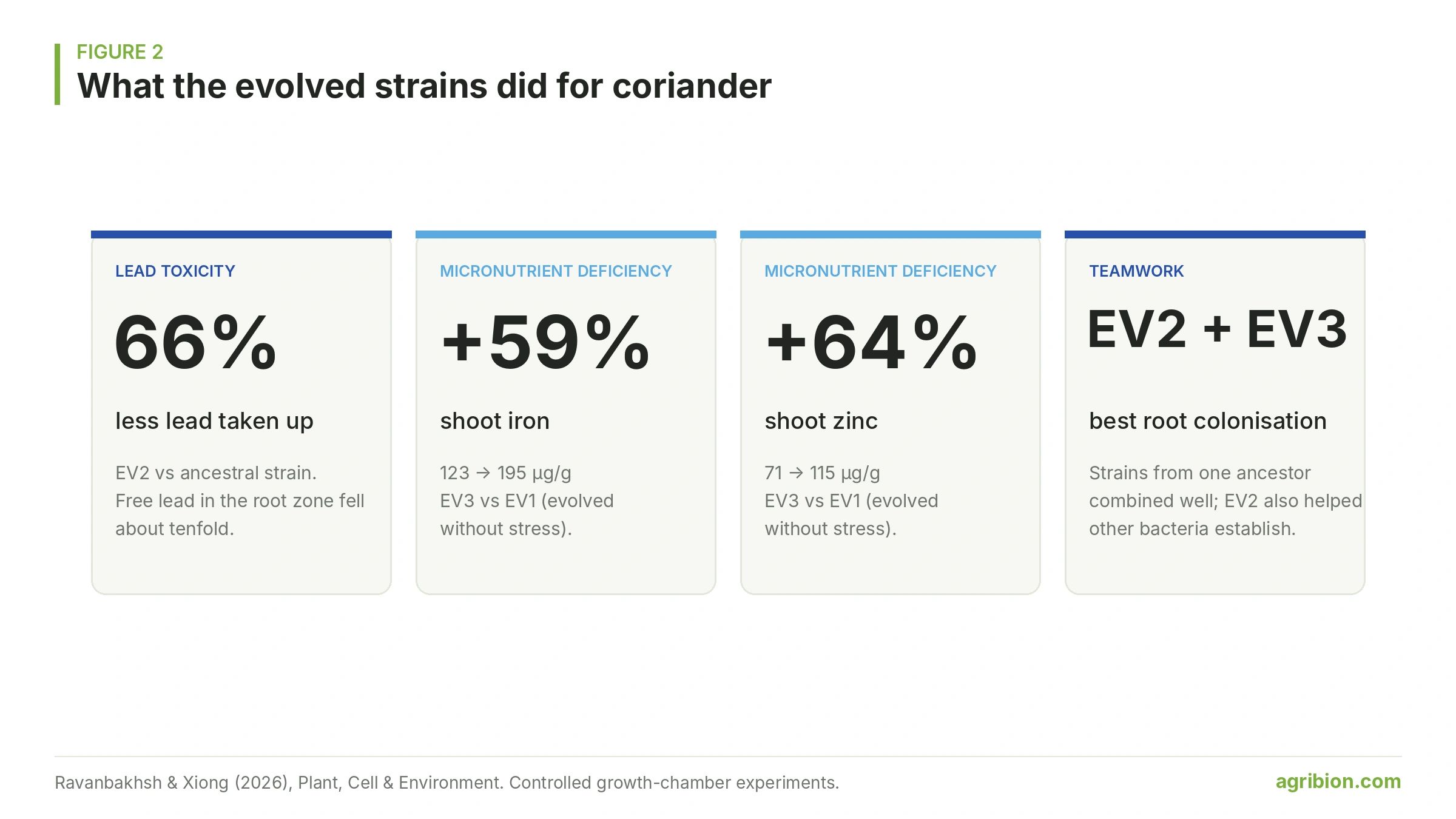
• Under lead toxicity: EV2 converted free lead in the root zone into less available forms. Plants took up 66% less lead than with the ancestral strain.
• Under micronutrient deficiency: EV3 made iron and zinc more available. Shoot iron rose from 123 to 195 µg/g and zinc from 71 to 115 µg/g, compared with the strain evolved without stress.
• As a team: because the strains share one ancestor, they combined with little competition. EV2 and EV3 together colonised roots best, and EV2 also helped other bacteria establish.
These are controlled experiments with one crop and a minimal community. The evolved strains are not genetically modified; fluorescent-tagged copies were used only in the step where bacteria had to be counted on roots.
Next: the field
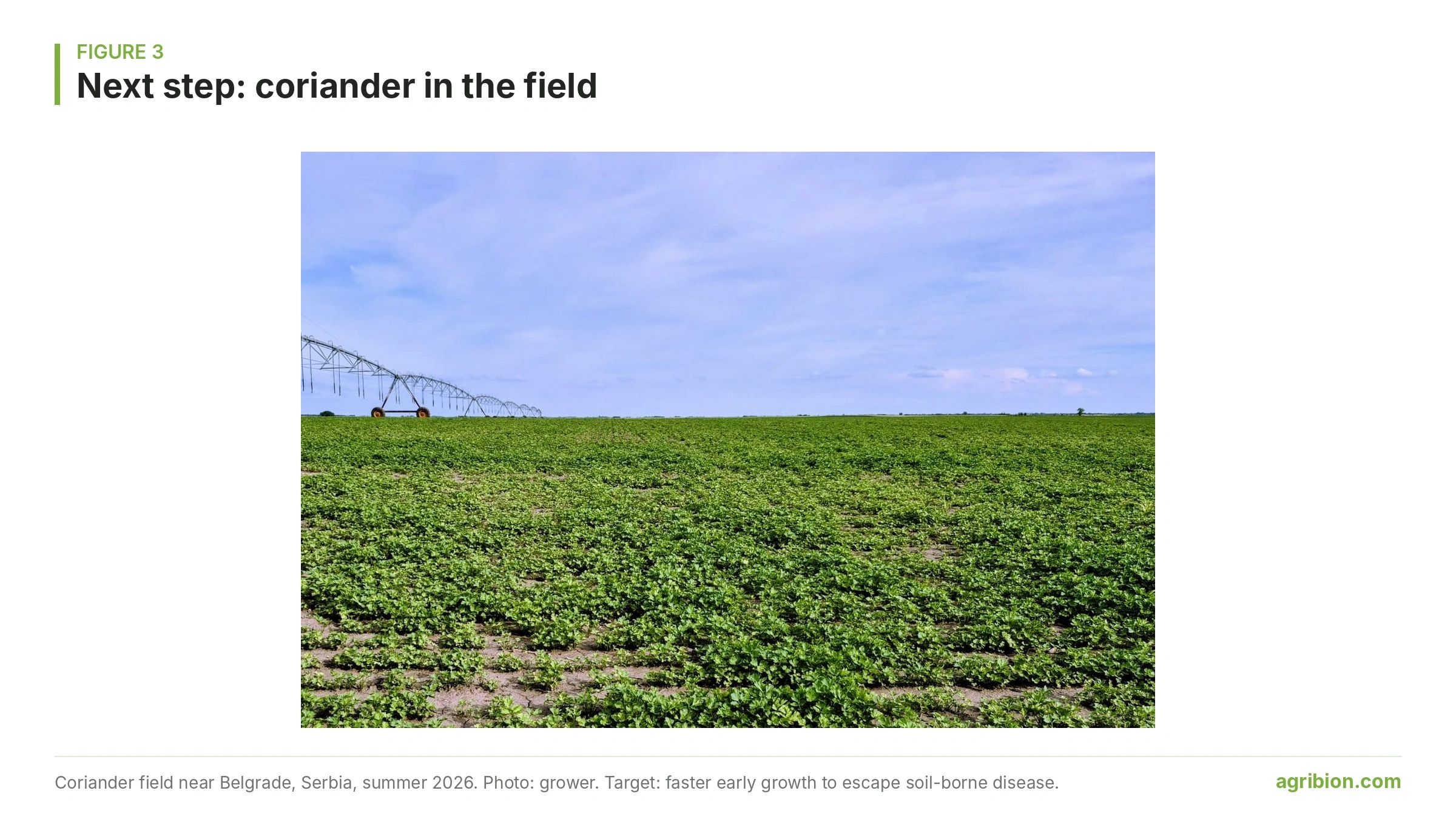
In summer 2026, Agribion took the approach to coriander fields near Belgrade, Serbia, with a new target: soil-borne disease. Seedlings are most vulnerable in their first weeks. The aim is to speed up early growth so plants pass this vulnerable window sooner (Figure 3). Here, fast early growth is exactly the trait the conditions call for; as Article 2 showed, a microbial trait should be selected for the conditions it will meet. We will report the field results in a later article.
Figure 3. Coriander field near Belgrade, Serbia, summer 2026 (photo: grower). Field results will be reported separately.
Need a microbial solution for a specific stress or crop? Contact Agribion to discuss evolving bacteria for your target conditions.
In this series:
Series overview: Article series
Previous: Article 2, When growth comes at a cost: https://agribion.com/growth-at-a-cost ·
Article 1, Improving plant traits through the microbiome: https://agribion.com/beyond-biologicals
Read the research:
Ravanbakhsh M, Xiong W (2026). Directed evolution of plant-associated bacteria enhances plant holobiont stress tolerance. Plant, Cell & Environment. doi.org/10.1111/pce.70710