
Improving plant traits through the microbiome
Fig. 1. Shoot ethylene relative to the respective control after changing a plant gene (eto1) or a bacterial gene (ACC deaminase deleted). Arabidopsis, controlled conditions; Ravanbakhsh et al. (2021), New Phytologist. The two-circle diagram is conceptual.
Changing one bacterial gene can shift a plant trait about as much as changing a plant gene. Microbial genes are a second target for plant improvement, alongside breeding.
Plant traits are not set by the plant genome alone
Breeding has transformed crop performance by working on the plant genome. But plants regulate growth, nutrition and stress responses through hormones, and root-associated bacteria can raise, lower or rebalance those hormones. In our 2018 review in Microbiome, we described this for ethylene, a hormone that links growth, nutrient uptake and stress responses. The central insight: plant physiology reflects the activity of both plant and microbial genes.
Same pathway, comparable effect
In our New Phytologist study, we changed the ethylene pathway in two ways: through a plant gene, and through a gene in the plant’s root bacteria, tested on wild-type plants (Figure 1). Deleting the bacterial gene for ACC deaminase, an enzyme that breaks down ethylene’s precursor, raised shoot ethylene about 2.45-fold. The plant mutation eto1, an ethylene overproducer, raised it about 2.2-fold, each relative to its own control. Both changes also increased shoot iron, zinc and copper.
The bacteria could also counteract the ethylene overproduction of the plant mutant. The mutation stayed in the plant’s DNA; microbial activity changed how it was expressed.
See Fig. 1. Shoot ethylene and shoot Fe, Zn and Cu after changing a bacterial gene (blue: wild-type bacteria vs ACC deaminase mutant) or a plant gene (red: wild-type Col-0 vs eto1). Adapted from Ravanbakhsh et al. (2021), New Phytologist.
What it means for plant improvement
For breeders, this is a proof of concept that microbial functions can be targeted alongside plant genetics. For biologicals developers, it supports selecting microbes for a defined physiological outcome. Because the microbial effect acts through a known hormonal pathway, its outcome can be predicted more reliably once the growing conditions are taken into account. Article 2 shows why those conditions matter.
This study used genetically modified bacteria in Arabidopsis under controlled conditions. It establishes a mechanism; crop performance and consistency across soils and seasons still require validation. In Article 3, we show how bacteria with targeted functions can be developed through experimental evolution rather than genetic modification.
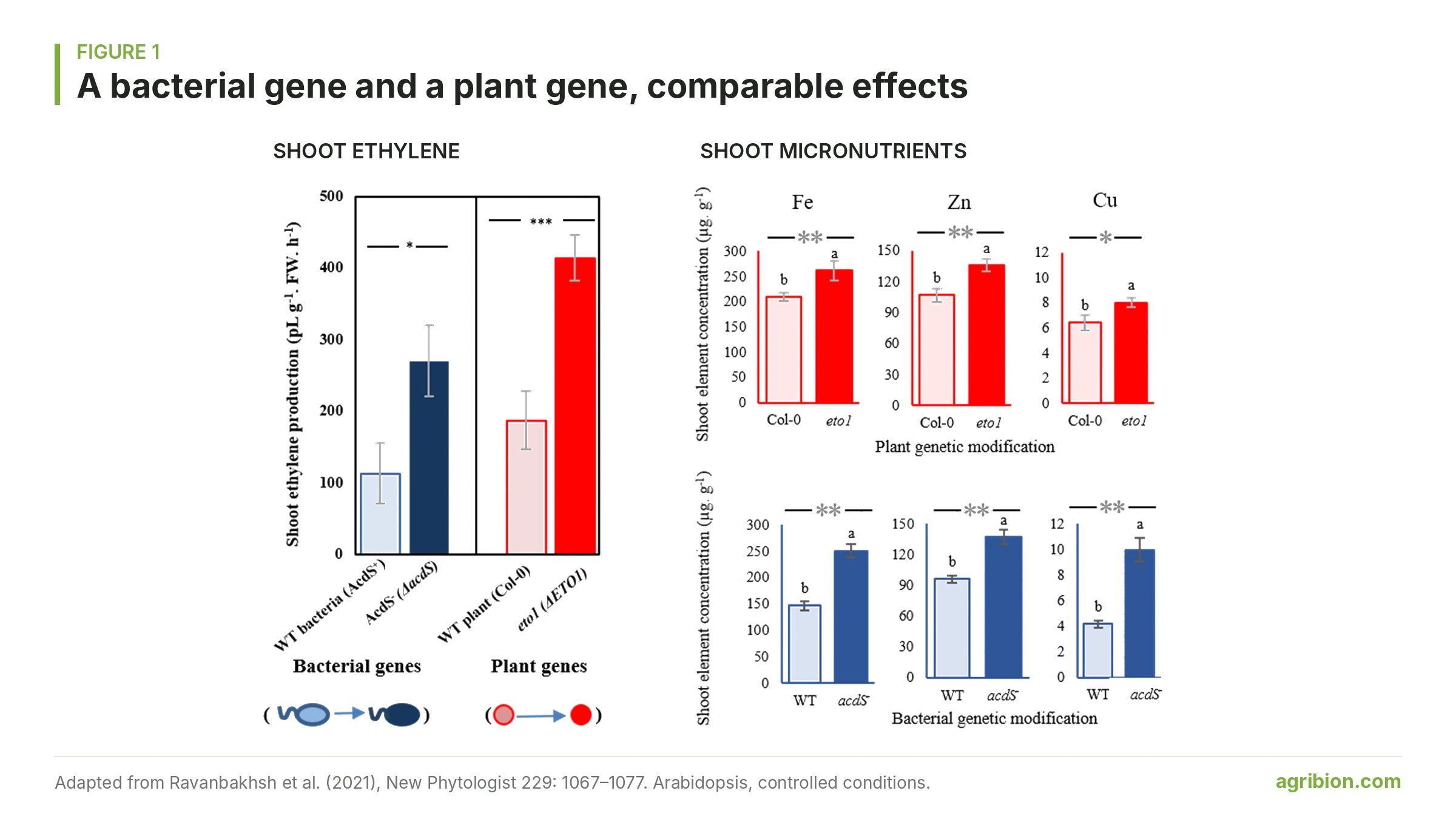
Figure 1. Shoot ethylene and shoot Fe, Zn and Cu after changing a bacterial gene (blue: wild-type bacteria vs ACC deaminase mutant) or a plant gene (red: wild-type Col-0 vs eto1). Adapted from Ravanbakhsh et al. (2021), New Phytologist.
Want a practical solution?
Exploring microbial functions alongside your breeding or seed-treatment programme? Contact Agribion to discuss a focused research collaboration.
Read more?
Ravanbakhsh M, Sasidharan R, Voesenek LACJ, Kowalchuk GA, Jousset A (2018). Microbial modulation of plant ethylene signaling: ecological and evolutionary consequences. Microbiome 6: 52. doi.org/10.1186/s40168-018-0436-1
Ravanbakhsh M, Kowalchuk GA, Jousset A (2021). Targeted plant hologenome editing for plant trait enhancement. New Phytologist 229: 1067–1077. doi.org/10.1111/nph.16867