WHEN GROWTH COMES AT A COST
Arabidopsis with wild-type bacteria, an ACC deaminase-deficient mutant, or no bacteria. Photos: Hecht ... Ravanbakhsh et al. (2025), Plant, Cell & Environment, CC BY 4.0. Diagram is conceptual
A microbial treatment that boosts growth in good conditions can become a cost under stress. Select it for the conditions it will meet.
The problem: variability of response in field application
Field results with biologicals are often variable. In the 2013–2016 field trials in Figure 1, the yield response to one microbial biological ranged from a loss of about 30 bushels per acre to a gain of more than 70. The chart does not show what caused the spread. It does raise the question every R&D team faces: in which conditions does a treatment pay off, and when does it cost yield?
Fig. 1 . Yield change across replicated trials and sales demonstrations, 2013–2016, from a public industry presentation. Product, crop and comparator not shown in the original.
Example 1: A growth–stress trade-off mechanism in microbiome application
Many beneficial bacteria carry ACC deaminase (11-16% reported in various studies), an enzyme that lowers the plant’s stress hormone ethylene. In our ISME Journal study, bacteria with this enzyme increased plant growth but made plants hypersensitive to cadmium stress. A mutant lacking the enzyme did the reverse. The bacteria moved the plant along the same trade-off as mutations in the plant’s own ethylene genes (Figure 2). Growth promotion was not free; it had a price that only appeared under stress.
Figure 2. Microbes and plant mutations shift Arabidopsis along one growth–stress trade-off (stress = cadmium). Adapted from Ravanbakhsh et al. (2019), The ISME Journal, Fig. 4.
Example 2: Drought makes it visible
Our Plant, Cell & Environment study tested the same bacteria under drought. With ample water, plants with the wild-type bacteria grew the most. As water ran short, they kept their stomata open, used soil water faster and then declined sharply. Plants with the mutant used water conservatively and kept growing into severe drought (Figure 3). One enzyme turned a growth benefit into a drought liability.
Figure 3. Representative rosettes under well-watered conditions and the most severe drought. Hecht et al. (2025), Plant, Cell & Environment, Fig. 1A (cropped), CC BY 4.0.
What this means for screening
These are controlled Arabidopsis experiments with one bacterial strain; they do not explain the field results in Figure 1. They do show that early vigour alone is an incomplete selection criterion.
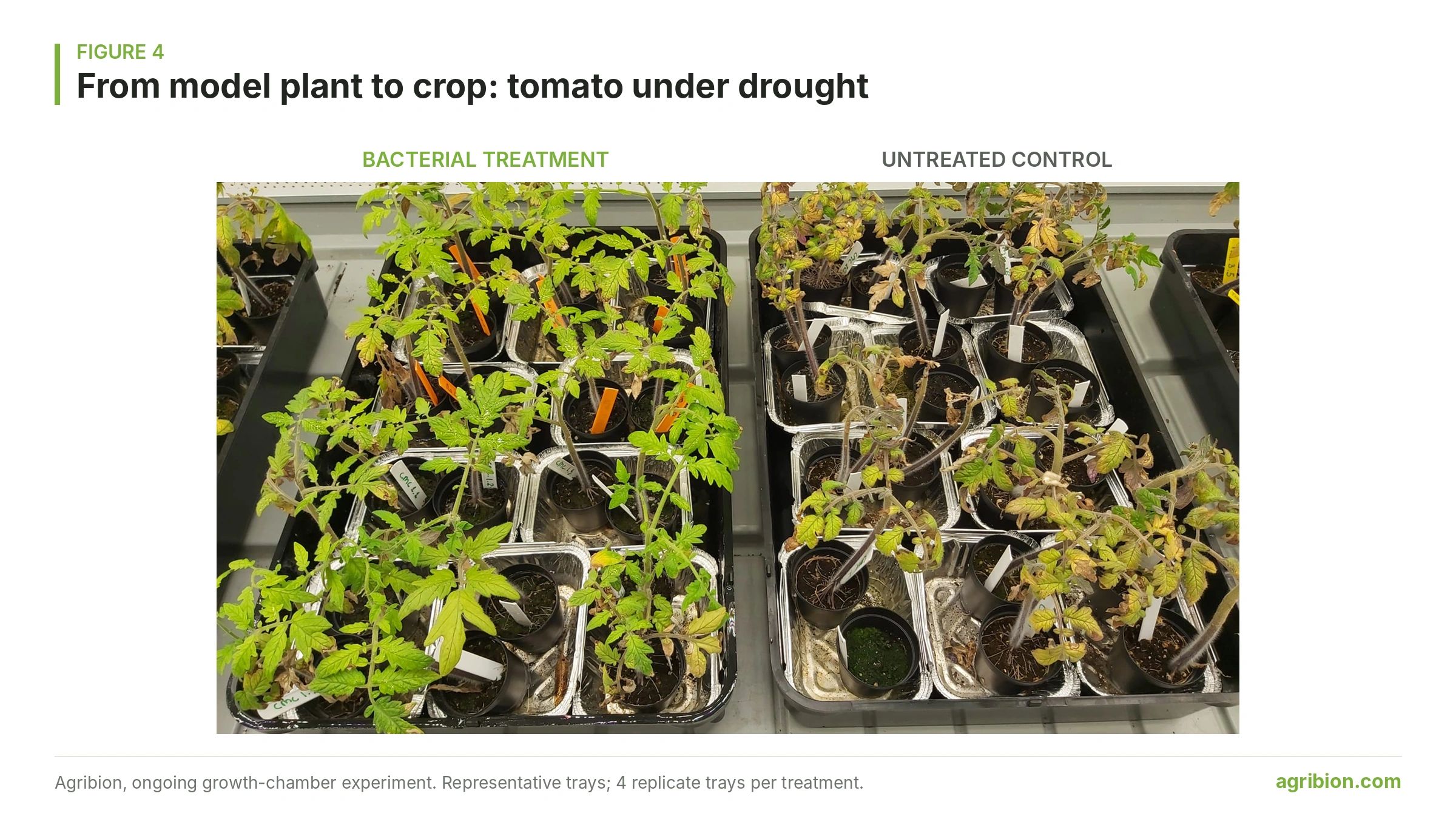
The same principle, however, carries over to crops. In an earlier growth-chamber experiment, we treated tomato with bacteria selected to shift the plant’s hormonal balance towards drought tolerance. Across four replicate trays per treatment, treated plants stayed visibly greener under 12-days drought than untreated controls (Figure 4). This was an exploratory test and has not yet been followed up in the greenhouse or field.
In practice:
• Assess growth and stress performance together.
• Test across the stress levels the product will meet in its target regions.
• Compare within the same cultivar and seed lot, and follow through to the commercial outcome.
Read more?
Ravanbakhsh M, Kowalchuk GA, Jousset A (2019). The ISME Journal 13: 3093–3101. doi.org/10.1038/s41396-019-0501-1
Hecht K, … Ravanbakhsh M (2025; online 2024). Plant, Cell & Environment 48: 1919–1931. doi.org/10.1111/pce.15265
Developing a biological seed treatment? Contact Agribion to discuss test designs that match microbial function to the intended growing conditions.